
Complaints and reputation – Updated 21 September 2026
Legit99 complaints Australia: withdrawal cases and reputation signals
 Available in AU
Public complaint records include Australian Legit99 withdrawal disputes, but the records do not all end the same way. The current Casino Guru complaint module lists seven cases overall, with two in its unresolved category and five in its rejected category. Individual case pages show why that distinction matters: some complaints were marked unresolved after the casino did not provide a constructive response, while several others were closed because the player stopped replying before the investigation could continue. Player allegations are not treated here as proven facts. The useful evidence is the combination of what the player alleged, whether the operator responded, what the complaint platform could verify procedurally and how the case was ultimately classified. The Legit99 Australia review provides the broader product and regulatory context for these complaint records.
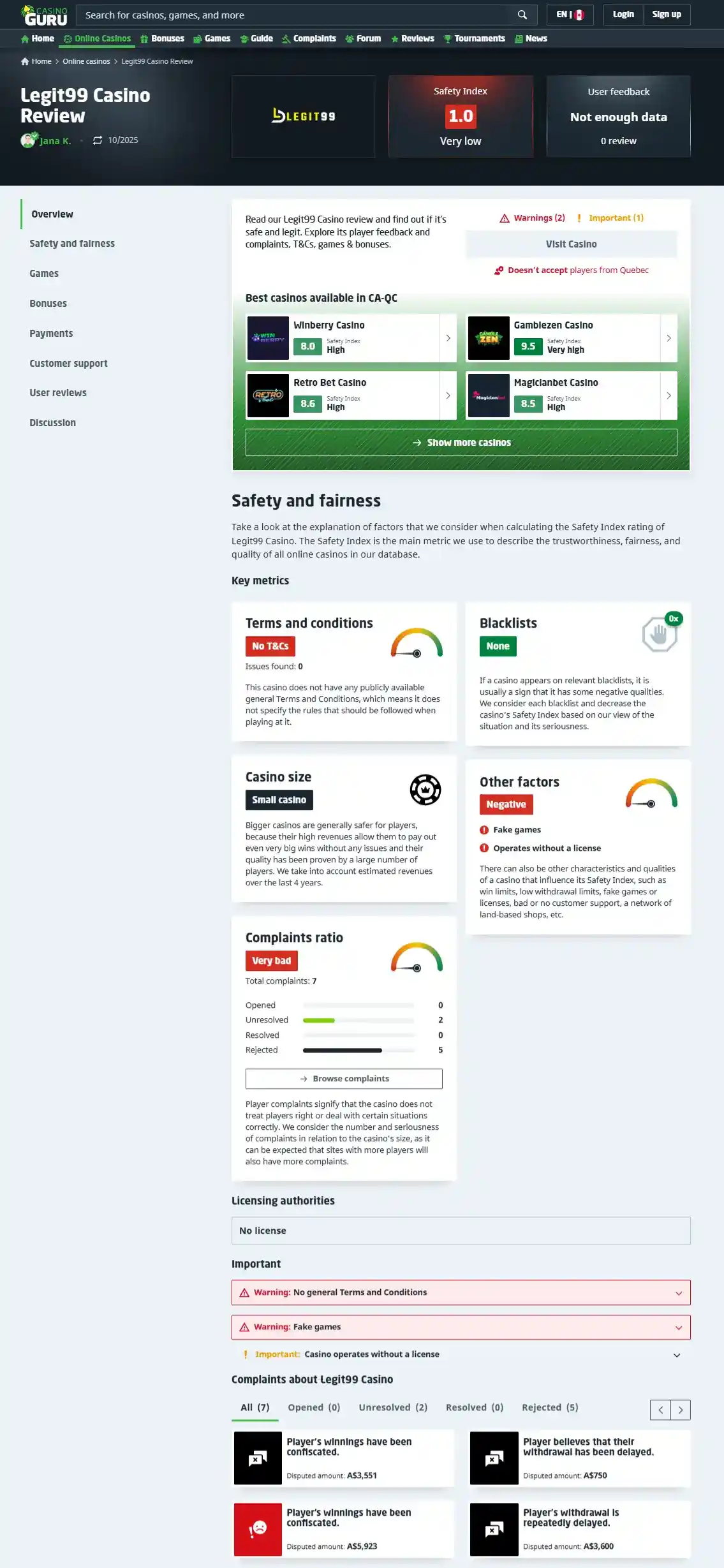
Table of Contents
- Current Legit99 complaint record at a glance
- What seven complaints do – and do not – tell you
- Unresolved is different from closed after the player stops replying
- What the Australian withdrawal cases have in common
- Public terms matter when a complaint turns on a rule
- Licence and ADR context affects escalation options
- Game-integrity evidence is a separate reputation signal
- How to preserve evidence if a withdrawal dispute starts
- How Legit99 complaint records should shape a risk-aware review
Current Legit99 complaint record at a glance
| Case | Player allegation | Platform process | Outcome |
|---|---|---|---|
| 27 Jul 2026 – A$5,923 | Australian player said winnings were forfeited after a withdrawal and disputed a “suspicious betting” explanation. | Casino Guru said it sought clarification and supporting evidence from the casino but did not receive a constructive response. | Unresolved on 24 Aug 2026. |
| 1 Aug 2026 – A$3,551 | Australian player said a withdrawal was rejected and winnings were forfeited after an irregular-betting allegation. | The complaint team asked follow-up questions, but the player stopped responding. | Closed on 25 Aug 2026 for lack of player response. |
| 11 Sep 2025 – A$750 | Australian player reported a delayed and repeatedly rejected withdrawal. | The complaint team could not complete the investigation because the player did not answer later messages. | Closed on 8 Oct 2025 for lack of player response. |
| 2 May 2024 – A$1,025 | Australian player disputed a denied withdrawal and an alleged multiple-account reason. | Casino Guru said it contacted the casino but did not receive relevant information. | Unresolved on 10 May 2024. |
The amounts above are disputed amounts recorded by the complaint platform. They are not independent confirmation that the player was legally or contractually entitled to receive that amount. The seven-case roll-up is useful as context, while the individual case pages remain the stronger source for dates, amounts and procedural outcomes.
What seven complaints do – and do not – tell you
The current Casino Guru profile lists seven Legit99 complaints in its complaint module: two unresolved and five rejected. That is a useful point-in-time view of the platform’s own case database, but it is not a complete measurement of every dispute that has ever occurred. Players can complain elsewhere, some disputes never become public, and complaint platforms apply their own intake and closure rules.
Complaint volume also needs context. A large operator can generate more complaints simply because it has more customers. Conversely, a small operator can have few published cases while still presenting material risk if the cases involve serious payment disputes or there is no clear regulatory escalation route. The review source itself describes Legit99 as a smaller casino and links its trust assessment partly to complaints, but this site does not reproduce that source’s proprietary score or ranking.
For the Australian licensing and consumer-protection context behind that escalation issue, see the licence and trust.
Unresolved is different from closed after the player stops replying
The most important distinction in the public record is procedural. An unresolved complaint can mean the complaint platform reached the end of its process without a satisfactory operator response or solution. In the July 2026 A$5,923 case, Casino Guru says it asked the casino to clarify the alleged rule breach and provide supporting evidence, but the casino did not cooperate with a meaningful explanation. The platform then marked the complaint unresolved.
By contrast, the A$3,551 and A$750 cases were closed after the players stopped responding to follow-up messages. That closure does not prove the casino’s position was correct. It also does not give enough completed evidence to treat the player’s allegation as established. The correct reading is narrower: a dispute was reported, but the platform could not continue its investigation because the complainant stopped participating.
This is why a simple count of “negative complaints” is less useful than reading the outcome mechanism. A rejected or closed case can reflect missing player cooperation, a complaint outside scope, insufficient evidence or another procedural reason. Those are not equivalent to an unresolved case where the operator failed to engage.
What the Australian withdrawal cases have in common
The four cases reviewed above all concern cash-out disputes, but the alleged reasons differ. They include suspicious-betting allegations, repeated withdrawal rejections, a multiple-account allegation and an account-access problem after a forfeiture dispute. That pattern is relevant to reputation analysis because it points to the withdrawal stage as the recurring point of friction in the public cases sampled here.
It should not be turned into a claim about a standard Legit99 withdrawal limit, processing time or fee. Those exact numbers remain unsupported by the primary evidence available for this project. The separate withdrawals explains what is verified and what is deliberately omitted.
Public terms matter when a complaint turns on a rule
Casino Guru’s current Legit99 review reports that it could not find publicly available general Terms and Conditions. That observation matters when a dispute turns on terms such as suspicious betting, bonus treatment or multiple accounts. A public, dated ruleset makes it easier for a player and an outside reviewer to compare the operator’s reason with the terms that applied at the time.
The absence of a public general-terms document in that review does not prove that no account-level rules exist. It does mean the external evidence base is weaker. When a complaint contains only the player’s account of a rule and no accessible primary terms, this page does not fill the gap by inventing the clause.
Licence and ADR context affects escalation options
No Australian local licence was verified for Legit99 in the ACMA register. Offshore licence claims also remain conflicting and were not primary-verified. That matters because a verified regulator or alternative dispute resolution channel can provide a route beyond the operator and a private complaint website.
Without a verified local licence, this guide does not claim that Australian licensed-wagering protections apply to a Legit99 online-casino account. The trust parent page explains why BetStop and the National Consumer Protection Framework should not be automatically attributed to this service.
Game-integrity evidence is a separate reputation signal
Withdrawal complaints should not be used to prove unrelated product claims. Separately, Gamecheck flags legit99.com with a “Fake Games Detected” finding, and the current Casino Guru profile says fake games were found in a checked selection from multiple providers. That finding is material to trust analysis, but it remains scoped to the tested sample rather than the entire catalogue.
Keeping these evidence streams separate prevents double counting. A complaint is evidence about a reported dispute and its handling. A game-integrity check is evidence about sampled game authenticity. A licence register is evidence about regulatory status. Strong reputation analysis asks what each source actually demonstrates instead of combining all negative signals into a single unsupported accusation.
How to preserve evidence if a withdrawal dispute starts
If a player is already in a dispute, the most useful step is to preserve a clear timeline before details disappear from the account interface. This is record-keeping guidance, not a promise that a complaint will be recovered or a substitute for legal advice.
- Keep transaction records: save deposit confirmations, withdrawal request timestamps, rejection notices and any status changes.
- Save support transcripts: export or save copies of live-chat and email exchanges, including dates and the support channel used.
- Keep the applicable rules: save bonus terms, account notices and any rule the operator cites in its decision.
- Document verification: keep a record that KYC was requested or completed, but do not post identity documents publicly or send them to complaint-site impersonators.
- Write a short chronology: separate what happened, what the operator said and what remains disputed.
- Use consistent amounts: record the requested withdrawal, current balance and disputed amount separately so they are not conflated.
If verification is part of the dispute, the KYC and verification explains the limits of the currently verified document evidence.
How Legit99 complaint records should shape a risk-aware review
The public case record is most useful as process evidence. It confirms that Australian players have reported withdrawal disputes and that at least two current cases are classified as unresolved, while several other cases closed because the player stopped responding. Those categories should not be flattened into the same conclusion.
For a risk-aware review, the stronger signals are repeat friction around withdrawals, limited public terms visibility and the absence of a verified Australian local licence or clearly verified ADR route. The proper response is not to label every allegation proven. It is to demand better documentation, keep complete transaction and support records, and judge each complaint by the evidence and procedural outcome attached to it.
Written by the editors at Legit99 Casino.